Sunday, April 12, 2020

April 12, 2020 - Prayer of the Week


Batter my heart, three-personed God, for you
As yet but knock, breathe, shine, and seek to mend;
That I may rise and stand, o’erthrow me, and bend
Your force to break, blow, burn, and make me new.
I, like an usurped town to another due,
Labor to admit you, but O, to no end;
Reason, your viceroy in me, me should defend,
But is captivated, and proves weak or untrue.
Yet dearly I love you, and would be loved fain,
But am betrothed unto your enemy.
Divorce me, untie or break that knot again;
Take me to you, imprison me, for I,
Except you enthrall me, never shall be free,
Nor ever chaste, except you ravish me.
- John Donne. Sonnet 14


Saturday, April 11, 2020

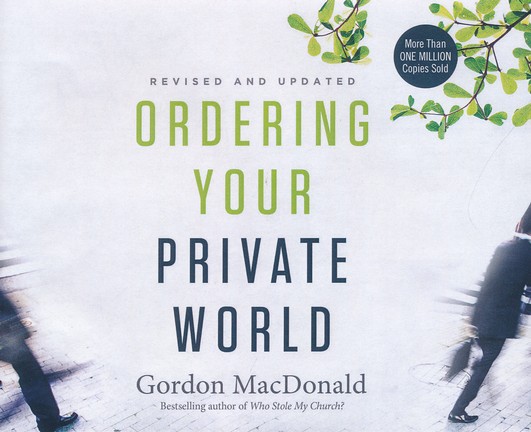
Book Review: Ordering Your Private World

Ordering Your Private World - unabridged audio book on CD: Gordon ...


MacDonald, Gordon. Ordering Your Private World. Revised. Nashville, TN: Thomas 
          Nelson, 2003.

Gordon MacDonald has served as a pastor in Massachusetts and as an interim president and now chancellor at Denver Seminary, among other roles he’s had over the years. He and his wife Gail have co-authored some books together, and Gordon has written over a dozen books on his own. He and Gail have two grown children and several grandchildren.

His book Ordering Your Private World is one of MacDonald’s forays into spiritual formation. In it he talks about the intentionality of pursuing growth, not just spiritually, but in all aspects of life. From investing in God’s Word to life-long learning, from taking Sabbath-rests to living with the sense of being called, MacDonald explores what it means to be more than just a skin-deep believer.

The book was born out of MacDonald’s own spiritual journey, and as such it is filled with personal stories. Not only does this make the book quite enjoyable to read, it also gives the reader ample opportunity to relate and resonate with MacDonald’s life experiences and subsequently to take him up on his stress-tested wisdom.

Perhaps the greatest takeaway from the book for me was the clear presentation of two pictures of life—one in which life flows from the inside out, and a bifurcated life in which things may appear all right on the surface, but the chaos hiding within will eventually lead to burnout, despair, and destruction. Though he mentions neither, I couldn’t help but think about Jesus’ description of the Pharisees as being externally clean cups and whitewashed tombs (Matthew 23:25-28), and his Parable of the Two Builders (Matthew 7:24-27). It is a sobering thought to think that there might be many people who believe in Jesus and cross all the external t’s and dot all the external I’s, but who are a complete mess on the inside. Sometimes that’s me.

Ordering Your Private World has sold over a million copies and has gone through a few reprints since it first came out in 1984. That’s a testimony of its timeless lasting power. If you’re just now entering into a pursuit of deepening your inner life, or, like me, need to be reminded of what that looks like and be encouraged in your walk, I highly recommend this book to you.

Grace and peace.

You can find this book at Amazon:

Sunday, April 5, 2020

Prayer for the Week: April 5, 2020


My God, let me know and love you, so that I may find my happiness in you. Since I cannot fully achieve this on earth, help me to improve daily until I may do so to the full. Enable me to know you ever more on earth, so that I may know you perfectly in heaven. Enable me to love you ever more on earth, so that I may love you perfectly in heaven. In that way, my joy may be great on earth, and perfect with you in heaven. O God of truth, grant me the happiness of heaven so that my joy may be full in accord with your promise. In the meantime let my mind dwell on that happiness, my tongue speak of it, my heart pine for it, my mouth pronounce it, my soul hunger for it, my flesh thirst for it, and my entire being desire it until I enter through death in the joy of my Lord forever. Amen.
- Augustine of Hippo


Thursday, April 2, 2020

Silence


“Silence is solitude practiced in action.” – Henri Nouwen

“Don’t just do something. Sit there.” This was the title of a message Haddon Robinson preached in 1991 on Luke 10:38-42. In that passage Luke recounts the story of Jesus’ visit to the house of Mary, Martha, and Lazarus. If you’re familiar with the story, you’ll remember that Martha was bustling about, trying to prepare a huge feast for her visitors (remember Jesus had at least 12 men in tow with him). Her sister Mary, meanwhile, simply sat at Jesus’ feet, letting Martha do all the work while she spent time with Jesus. This naturally perturbed Martha, who finally had enough and complained to her guest that he needed to send Mary to help her in the kitchen. Instead, Jesus refused, saying that Mary had chosen the better thing, and it wouldn’t be taken away from her.

Sometimes we can be so caught up in human doings that we lose sight of the fact that we are human beings, created and designed for intimacy with God. The spiritual discipline of silence helps to realign our hearts with this truth.

Before silence can happen, solitude must first exist. “Silence is the way to make solitude a reality,” Henri Nouwen once wrote (The Way of the Heart). For more on solitude, check the previous blog entry for my thoughts on that

WHAT IS SILENCE?

At the heart of silence is listening. It’s impossible to listen when we ourselves are talking. But this listening should not be to the world or people around us, but rather a listening for God. God rarely shouts. His word to us is often whispered. Only those who still their tongues, quiet their hearts, and remove all the distractions this world affords will be able to catch such a whisper. We live in a loud world; it screams and shouts in its demands for attention. The Prince of this world wants nothing more than to pull us farther and farther away from the God who created, saved, and loves us. In order to draw nearer to him, we must enter into quietness.

According to Nouwen, there are three phases in the transformational power of silence. Silence is a journey, an encounter, and a testimony.

Since speaking is the way of the world and often leads us into sin (cf. James 3), entering into silence is like taking a pilgrimage to another land. By definition, a pilgrimage is a journey, usually a long one, often made to a sacred place. By entering into silence, we take a trip from the loud world around us to a quiet, separate place, an alternate reality, if you will.

Of course, most religious devotees go on a pilgrimage to a sacred place in order to experience a greater awareness of God, or at the least, receive some manner of blessing from him. The inward journey of silence allows us to encounter the Spirit who dwells within us. When we close our mouths (including our inner voice) and remove ourselves from all the distractions around us, we can come near the inner fire of the Spirit.

Imagine your normal routine being like a house on a cold winter’s night with every door and window thrown open. Yes, there is a fire in the hearth, but the cold and the wind are pervasive. It’s hard to feel the heat at all. Entering into silence is like going around and closing all those doors and windows to the outside. Slowly then the heat from the hearth builds until it gives comfort and peace and assurance. So it is with the warmth of the Spirit when we can shut out all other distractions, including our own words. It is in this context that we can rest and listen for the soft whisper of the Master, the whisper that says, “I love you. No matter what you do or what is done to you, I will never stop loving you. You are mine. I will never leave you or forsake you.” In our brokenness, battling our hurts, hang-ups, and habits, we desperately need to hear such whispers, and hear them often.

In its final stage, our experience with silence leads us to bear testimony of it. The whisper of God that we catch in the silence of our interior lives becomes a beautiful and powerful secret that we cannot keep to ourselves. The culmination of silence is, oddly enough, the ministry of the word, where our message to others brings healing, hope, peace, joy, and above all, love.

Think about it. How often have you walked away from a conversation thinking to yourself, “Well, that could have gone better!” Or, “Why didn’t I think to say that?” How often are our words more hurtful or harmful than helpful? The discipline of silence will help us to change that trend.

HOW DO WE PRACTICE SILENCE?

It is important to note that the goal of this discipline is not to create an empty silence, but rather a full silence, a silence permeated with the presence of God.

As silence comes from within the context of solitude, it is critical to find a safe place and an undisturbed time to practice it. Find a location and a time of the day that works for you. Next, eliminate distractions. Turn off your phone. Lock out the cats. If you’re going to be distracted by checking the clock, set a timer. Whatever distraction can be removed from your space, remove it.

Next, listen. At first this will be a struggle. All the things swirling about in your mind will start to scream for attention. Resist attending to them. Your inner voice will tell you this is a waste of time. Ignore it. Your mind will wander. Order it hack to your place of silence. This whole exercise will seem impossible and hopeless at first, but if you stick with it, silence will come easier and easier.

Sometimes when I am greatly distracted with a great many things, I will turn to a centering prayer. I’ll blog more about them in a later post, but a centering prayer is generally two lines long, slowly repeated over and over, with the first line on our inhalation, and the second line on our exhalation. My go-to centering prayer is this:

(Inhale) I am your beloved son/daughter, whom you love;
(Exhale) With me you are well-pleased.

This “centers” me on the truth of this prayer that I can claim because I am in Christ. (Since the Father said it of Jesus, and since I am now in Jesus, the Father says it of me.) When I get to that point of focus, I then invite God into the space this has created, and I become still and silent. And I listen.

Sometimes I catch that whisper. Sometimes I don’t. Regardless of how it goes, I conclude my time of silence with a prayer of thanksgiving.

In his book Ordering Your Private World, Gordon MacDonald compares the stories of Moses and Aaron when the people of Israel were encamped at the foot of Mt. Sinai. Moses spent forty days and nights in silence, listening to the word God had for him. Aaron, on the other hand, spent that same amount of time listening to the people around him. One heard the love and affirmation of God and was encouraged to fulfill God’s call on his life; the other heard the complaints and criticisms of the people, and was so discouraged he disastrously gave the people what they wanted instead of what they needed. How you and I finish in this life will depend a great deal upon to whom or what we listen.

The fruit of silence is a powerful word from God that we cannot keep to ourselves. I encourage you to give the discipline of silence, with its sister discipline of solitude, a try some time.

Grace and peace.

Tuesday, March 24, 2020

Solitude

“We must be made aware of the call to let our false, compulsive self be transformed into the new self of Jesus Christ. It also shows that solitude is the furnace in which this transformation takes place.” – Henri Nouwen, The Way of the Heart

Solitude can be a frightening thing in our highly “social” world. Being alone with nothing but ourselves and God is not for the faint of heart, for in such a context we are completely exposed, naked in our brokenness before an all-seeing, holy, and righteous Being. There is no place to hide, no one caught in “bigger” sins or experiencing “greater” struggles for us to cower behind, and, if we’re honest, no one or thing to blame but ourselves for our wretched condition.

And yet . . . it is in this isolation that the compassionately tender and steady hands of our loving Father can perform his most effective surgeries on our hearts.

I’m writing this in the midst of the 2020 COVID-19 pandemic. It’s a time when hundreds of millions of people are in “lockdown,” ordered to stay at home as much as possible as our world’s nations attempt to “flatten the curve” and save as many lives as possible. And though we have countless means of entertainment and distraction at our fingertips—at least here in my middle-class Midwestern context—many of us find ourselves, well . . . restless. What better context to dive into the spiritual disciplines of solitude and silence?

Henri Nouwen insists that there is a three-fold purpose to solitude—first, it allows us to drop our false selves, then it allows God to transform our real selves into something more resembling Jesus, and finally, from our real selves we are able to more effectively proclaim the good news of Jesus and minister to those around us. That seems like a worthy goal to me.

SOLITUDE AS BOTH BATTLEGROUND AND BEAR HUG

When we practice solitude, we enter an arena. Our fight is against not only the false self, who is formidable in his own right, but also against the forces who created and control our false selves—the three main compulsions of the world:  to be relevant, to be spectacular, and to be powerful. Jesus encountered these same inner foes during his forty days of solitude in the wilderness (and assuredly at many other points in his ministry), so we too must enter the desert in order to face them down and strip ourselves of the false self they so quickly and adeptly create for us.

At the same time, solitude is where we can most easily encounter the loving embrace of our Abba. When we can shut out the world and all its demands and distractions, the presence of Immanuel, “God with us,” becomes more tangible and approachable. This offers us great encouragement, because not only do we have an Advocate who will fiercely and effectively fight on our behalf, but One who will softly and tenderly love us and tend to our wounds no matter how badly or how often we lose in our struggles against the things that force us to become imposters and frauds in an effort to conceal our imperfections and addictions.

SO HOW DO WE DO IT?

I believe it’s important to “prime the pump” for solitude. And by that, I mean investing in some Bible intake. When Jesus faced his trial of solitude and temptation in the wilderness, it was clear that he had made an extensive investment in God’s Word, and it was this investment that helped him overcome the foes he encountered on his own personal battlefield. Scripture is not only God’s Word for us, but it’s also God’s mirror for us. It helps to show us who God is and who we are, and who we’re supposed to be.

The first key to solitude is finding a place free from distractions—no people, no screens, no tasks. Just you and space. Such spaces are growing rarer in our culture. Kyle Idleman uses a closet he’s cleaned out. I use my favorite chair in the living room. Second, find a time and stick with it. For me, it’s early in the morning when no one else is up.

Then I spend time with myself, just me and God. I reflect on my recent actions and interactions. What were the motivations behind them? What is making me tick? What is driving my behavior? What about me is not fully surrendered to God? What am I hoping to hide from others about myself? What am I anxious about or fearful of, and why? Who am I at odds with, and why? What lies hidden, perhaps even from me, under the dark currents pf my heart?

It’s not necessarily a pleasant experience. Who wants to face the ugly things about ourselves? But unless we do, we will never come to a point where we are able to give those things to God and have him change them into something wonderful.

Such introspection has one of three outcomes. I could simply recoil in shock and denial and assume my false self once more. I could grit my teeth and commit once again to “white-knuckling” against my brokenness in my own power. Or I could realize my truly helpless estate and turn to Jesus in complete surrender.

And every time I turn to Jesus, he is right there beside me. The journey into solitude, oddly enough, is never a journey we take on our own. Jesus is with us, every step of the way if only we look to him. And when our struggle against the ugliness we see in our hearts begins to crush us and defeat us (and when does it ever not?), we can fall into the tender embrace of Jesus and let him take up the fight for us.

Introspection of self, acknowledgment of powerlessness, surrender to the unquenchable love of God. These are the elements of solitude.

The fruit of solitude, of course, is a compassionate response to the brokenness of those around us. When we have a greater appreciation for our own shortcomings, when we recognize our own powerlessness over them, and when we realize that God loves us and rescues us despite our hurts, hang-ups, and habits, our judgmental superiority in reaching down to “help” others will slowly be transformed into a transparent compassion that reaches out to our fellow man.

This was one of the many differences between the Pharisees and Jesus. And it can be one of the many differences between who we are now and what we can be, with God’s help. Practice solitude. We’ll look at the discipline of silence in the next post.

Grace and peace. 


Saturday, February 22, 2020

What's Lent All About?


Mardi Gras (Fat Tuesday) and Ash Wednesday are coming up next week, kicking off the season of Lent. So what's up with all that, anyway?

Traditionally in the church universal, Lent is the period of 40 days prior to Holy Week (the time in which we commemorate the week of our Lord’s earthly ministry in which he was crucified, buried, and raised to life).  It gets its name due to the time of year in which it occurs—“Lent” is an Old Saxon word for “spring.”

As Advent is a season of anticipation for the coming of Christ, both past and future, Lent is a season of preparation to participate in the saving actions of Christ.  The number 40 is significant in the Bible; it represents a time of testing and preparation.  Early on (2nd century), the church used this period as a time to prepare converts for baptism, and soon it became a time for those already baptized to remember their baptismal vows, repent of sin, and recommit themselves to their calling.
              
By the 5th century, the beginning of this season became known as Ash Wednesday, due to the practice of applying ashes to one’s forehead as a sign of a penitent spirit.  Some Christians still do this practice today. Mardi Gras celebrations are not necessarily all that edifying, as the roots of its tradition are grounded in overindulging in pleasures and passions the night before the season of Lent---to "store up" these pleasures in preparation for a season of fasting from them. While I encourage people to experiences Lent, other than the good New Orleans based cajun and creole food, I do not recommend a deep dive into the seedy underbelly of Mardi Gras.

WHY DO PEOPLE GIVE UP THINGS FOR LENT?

Lent should not be looked upon as a season in which to give up something, but rather as an opportunity to gain something new.  Lent helps us to regain our focus on Christ, helps us to take our own moral pulse, and helps us to draw nearer to God through acts of repentance, charity, and discipline.  As Don Saliers puts it, “It is time for putting aside the sins and failures of the past in order to journey toward who we are yet to become by the grace of Christ in baptism.”
            
“Giving up” something for Lent should be the result of gaining one of three things:  (1) abandoning a habitual sin, (2) being able to spend more time with God, or (3) helping those in need with the money that was saved by giving up something.  When this approach is taken, we are not giving up something as much as we are gaining something far better.

IS LENT FOR ME?
            
The answer to that question lies with you.  The season of Lent, like all the facets of the Christian year, is a tool for spiritual discipline, and all spiritual disciplines have one aim:  to draw us closer to Jesus in relationship and in likeness.  If you think observing the season of Lent can help you achieve those ends, I encourage you to embrace it.  If you’re not sure, give it a try; you can always walk away if it isn’t helpful.  And if it’s not for you, that’s all right; find some other tool for a spiritual discipline that will help you achieve a closer friendship with and resemblance to Christ.

If you’d like to have a special time of Scripture meditation during Lent, below are some suggested passages to give you a jump start.

Suggested 2020 Lenten Season Devotional Readings
2/26
John 17:1-8
3/18
Genesis 45:16-28
2/27
Amos 5:6-15
3/19
Psalm 86
2/28
Psalm 80
3/20
1 Corinthians 9:16-27
2/29
Philippians 4:10-20
3/21
Mark 7:1-23
3/1
John 12:44-50
3/22
Genesis 48:8-22
3/2
Genesis 37:1-11
3/23
Psalm 132
3/3
Psalm 45
3/24
1 Corinthians 11:17-34
3/4
1 Corinthians 2:1-13
3/25
Mark 8:11-26
3/5
Mark 2:1-12
3/26
Exodus 1:6-22
3/6
Genesis 40:1-23
3/27
Psalm 102
3/7
Psalm 138
3/28
1 Corinthians 13:1-13
3/8
Romans 6:3-14
3/29
John 8:46-59
3/9
Mark 3:7-19
3/30
Exodus 4:10-20
3/10
Genesis 42:1-17
3/31
Psalm 121
3/11
Psalm 72
4/1
2 Corinthians 2:14-3:6
3/12
1 Corinthians 6:12-20
4/2
Mark 10:17-31
3/13
Mark 4:35-41
4/3
Exodus 9:13-35
3/14
Genesis 43:16-34
4/4
Psalm 42
3/15
Psalm 96
4/5, Palm Sunday
Luke 19:41-48

3/16
1 Corinthians 7:25-31
3/17
Mark 6:1-13

Suggested Readings for Holy Week
4/6
Mark 11:12-25
4.7
Mark 11:27-33
4/8
Mark 12:1-11
4/9, Maundy Thursday
Mark 14:12-25
4/10, Good Friday
John 19:38-42
4/11, Holy Saturday
Romans 8:1-11
4/12, Easter
Luke 24:13-35


Wednesday, February 19, 2020

The Corporate Spiritual Retreat


Last October I attended my second Christ in Youth Wilderness retreat. It’s a five-day long gathering, mostly of youth ministers, up in the Rocky Mountains overlooking Colorado Springs at a beautiful place called Bear Trap Ranch.

The days are scheduled, but somewhat loosely, allowing participants to map their own retreat for the most part. In the mornings we breakfasted, gathered for a short period of corporate devotion, and then given until lunch to work on some guided devotional time. For the 2019 session, our text was the Sermon on the Mount (Matthew 5-7). We were encouraged to find a quiet spot out in the wilderness as we did this. There was also plenty of discretionary time before lunch.

After lunch was free time, in which participants had opportunities to hike, fish, sightsee, read, nap, play games, etc., until dinner. When dinner was done, we moved to a time of corporate worship, which consisted of praise and proclamation. Immediately after this, we got into our assigned small groups. Small groups were assigned according to age and years of ministry experience. In the small groups, we’d discuss our life and ministry situations, the devotional questions we were given that morning, and anything that stirred us regarding that evening’s message. By then it was 10 pm or so, and usually time to hit the sack.

Corporate spiritual retreats vary in size and shape. But there are at least four elements they have in common with one another that prove valuable to those of us seeking to make space for God in our lives.

WORLDLY DISCONNECTION
One has to ask, what is one “retreating” from? Simply put, we are retreating from the everyday burdens, concerns, anxieties, distractions, and pleasures the world offers. At Bear Trap Ranch, one needs to travel about a mile away just to get cell service, and even then it’s spotty. The ability to get away from all that the world affords is invaluable in drawing closer to God. Jesus himself made it a habit of going to lonely places for opportunities to better commune with the Father.

IMMERSION IN CREATION
Due to their isolated nature, most retreat locations offer an opportunity to spend a good deal of time in God’s creation. This is an important part of the spiritual life that often gets overlooked in the hurly-burly of modern urban life. While Scripture is God’s special revelation to his people, creation is his general revelation to all people. Spending time in nature and grasping just a little bit of its amazing complexity and design help us to recapture our wonder and awe of the One who made it all.

GUIDED SELF-REFLECTION
Peter Scazzaro says, "The degree to which you recognize and engage your own shadow is the degree to which you can free others to face theirs" (The Emotionally Healthy Leader). The times of solitude that are provided (ironically) at a corporate spiritual retreat are priceless opportunities for us to spend time with ourselves, allowing the mirror of Scripture to show us what we are really like, and to help us identify areas in our lives that are not yet yielded up to Jesus. We can only lead people as far as we ourselves have gone. Solitude and self-reflection are great tools for personal growth.

COMMUNITY PARTICIPATION
For me, the best part of a corporate spiritual retreat is the “corporate” aspect of it. Spending a week with like-minded lovers of Jesus in pursuit of a deeper relationship with him is a little foretaste of heaven for me. We share our victories, our struggles, our praises, and our failures with one another. Because of our common specialized vocation at Wilderness, combined with CIY’s intentional grouping of participants, there is often great resonance with one another in most facets of our lives. The support, encouragement, correction, and challenges we receive from one another are amazing ways for God to speak to our hearts and help fashion them more after his.

I’ve heard a lot of reasons why people don’t attend corporate spiritual retreats. “I’m not an outdoors guy!” Neither am I. “It’s too expensive!” Beg, borrow, and plead if you have to. How much is your walk with Jesus worth to you? And a five day retreat like Wilderness is very reasonable in price. “I wouldn’t know anyone there!” Bring a buddy. Or come to Wilderness and look me up. I’ll be your friend.

You know my take on the spiritual disciplines. Not everything is suited for every person. But you owe it to yourself, to God, and to those you are investing in to at least give the corporate spiritual retreat a try. If it’s not for you, at least you’ll know. But I’m betting the experience will bless your life and the lives of those around you.

Grace and peace.